


Improving Balance After Guillain-Barré Syndrome
Using STROLLL to Rebuild Balance and Confidence After Guillain-Barré Syndrome
Improving Balance After Guillain-Barré Syndrome: A Neurological Physiotherapy Case Study
How STROLLL rehabilitation helped improve balance, gait and confidence after Guillain-Barré Syndrome
The following case study describes the experience of one patient using STROLLL at Neurological Physiotherapy. Identifying details have been anonymised, but this is a true account of her treatment and progress under our care.
About STROLLL
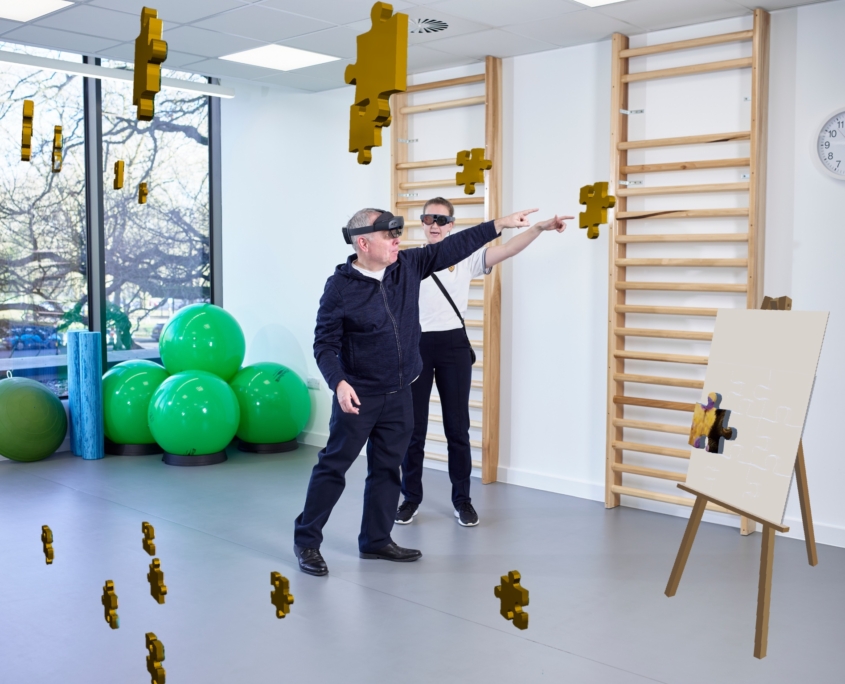
STROLLL is an innovative rehabilitation system designed to support people living with neurological conditions that affect walking, balance, posture, coordination, and confidence with movement. Using lightweight, see-through augmented reality glasses, it projects interactive exercises and visual movement cues into the real world, allowing patients to practise meaningful everyday activities while remaining fully aware of their surroundings.
Unlike virtual reality, STROLLL does not remove you from your environment. Instead, it creates engaging, task-specific rehabilitation that supports safe, functional movement and promotes neuroplasticity – the brain’s ability to relearn and adapt after neurological injury or disease.
Getting Started
M first came to us for a STROLLL demo session, curious about whether the system could help with her rehabilitation goals of improving her balance and gait.
She enjoyed the trial and booked a set-up session, where a physiotherapist explored her goals in detail, built a personalised six-week treatment plan around her individual needs, and assessed her balance using the Berg Balance Scale. The plan was to repeat that assessment after the six-week block, giving us an objective measure of how the STROLLL intervention had affected her balance and a clear way to track her progress.
At the start of the programme, M mobilised predominantly using a stroller.
Week 1: Finding Her Feet
In her first STROLLL session, M practised mobilising with two sticks.
STROLLL offers a range of games for gait training. In puzzle walk, patients walk around the room collecting pieces by reaching at various heights to complete a jigsaw. Mole patrol is a take on whack-a-mole, where you walk around stomping/squatting on moles as they emerge from their molehills. Smash box is a boxing game in which you mobilise then punch objects appearing on podiums. There is also a dedicated gait training mode, which M found particularly useful: a track appears on the ground for her to follow, with obstacles that can be added if additional challenge is appropriate.
We added a visual cue in the form of a balloon for M to focus on, which encouraged trunk extension, opening through the chest and better overall posture. To help her stay relaxed, we worked on breathwork and bringing her shoulders down from her ears.
For standing balance we used hot buttons, a reaction-based game where you balance and tap buttons as they flash, along with basketball shooting. M used two sticks throughout the session.
Week 2: Building in Progression
Going into week two, we made some adjustments to encourage progression and adaptation.
During basketball shooting, the settings were altered so that M had to complete five squats to earn a ball – targeting leg strength alongside balance. We also changed the settings for puzzle walk so that she had to reach for pieces at head height and down on the floor, all movements she is aiming for being confident in doing in everyday life.
Every game in STROLLL is designed to simulate real-world tasks that people with neurological conditions often find challenging. Hot buttons and puzzle walk, for example, work on reaching and rotating through the trunk – exactly what you need to get something out of a cupboard or reach into a wardrobe.
Week 3: The First Signs of Change
Friends had commented in the week how much straighter M was standing, and she had noticed she could now stand for 20 minutes while waiting for a taxi.
During gait training that day she mobilised using her two poles, with the rehabilitation assistant (RA) alongside for support. In previous sessions the RA had needed to be hands-on to correct M’s balance; this week her hands simply hovered – a clear sign that M’ was self correcting her balance. M reported that her legs felt stronger.
Week 4: Stepping Away from the Sticks
During the week M had been able to stand independently, with no walking aid, to cook herself a stir fry.
M was able to balance independently during hot buttons with the plinth behind her and the RA on hand for safety.
During smash box she mobilised with her sticks, pushing herself to lift them off the ground for a few steps at a time. That gave her the confidence to attempt puzzle walk with no walking aid at all, with the RA behind for assistance. When M moved across to play basketball, she didn’t think to pick up her sticks and instinctively took a few steps without them – a very emotional and proud moment.
Week 5: Independence at Home
Week five brought more significant milestones. M was now mobilising around her flat without a walking aid. Where she had previously relied on the walls for balance, she no longer needed them. She had grown far more confident in open spaces, particularly moving from her bedroom to the bathroom, and was balancing independently during everyday tasks such as cooking, cleaning, and putting clothes away. She was also now walking in front of colleagues at work.
During the squats, M noticed a tendency to lean on her right leg because of ataxia on her left side, so we focused on squeezing and contracting the right glute to bring her weight back through the centre. She mobilised again without sticks, with the RA behind for support.
M also managed to dual-task, holding a conversation with the RA for the full five minutes while rotating through her trunk and extending out to reach the buttons -something she had previously found difficult, as concentrating on speaking would affect her balance. We have found with M that doing her rehabilitation through games distracts her from overthinking regarding her balance and gait, which in turn makes both better.
Week 6: Measuring the Change
In week six we repeated the Berg Balance Scale to measure the effectiveness of the six-week STROLLL intervention.
Berg Balance Scale Baseline: 25/56 → Week 6: 44/56 – An improvement of 19 points and indicating that M is now at a much lower risk of falls.

What This Guillain-Barré Rehabilitation Case Study Shows
This case study demonstrates how personalised neurological physiotherapy can support recovery following Guillain-Barré Syndrome. By focusing on balance, gait, mobility and confidence, M made measurable improvements over six weeks and became more independent in everyday activities.
STROLLL provided an additional way to practise balance and walking within meaningful, functional tasks. While recovery from Guillain-Barré Syndrome is different for everyone, specialist physiotherapy and rehabilitation can help address ongoing balance, walking and mobility difficulties and support people in working towards their individual goals.
